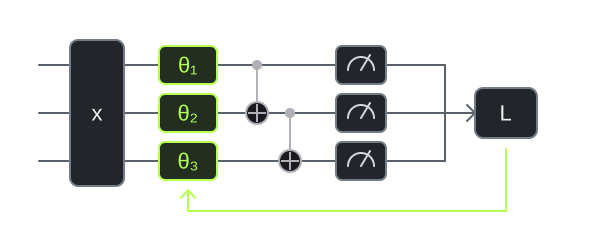
Repeat forward passes, loss evaluation, gradient computation, and parameter updates.
MODULE / 02 · QUANTUM MACHINE LEARNING
ArcQML Rust-native
Connect parameterized circuits, state simulation, automatic differentiation, and classical optimizers in one workflow for building, training, and validating quantum neural networks.
ArcQML uses hybrid noncommercial source-available licensing, not an OSI-approved open-source license. The official closed-source Runtime is licensed separately. Read the license summary
ArcQMLQuantum–classical training loop
- Core capabilities
- Automatic Differentiation
- Workloads
- Quantum Neural Network
- Comparison dimensions
- Training / Validation
FRAMEWORK / 01
Connect quantum circuits
with classical training
A unified interface organizes data encoding, parameterized circuits, gradient computation, and parameter updates, with consistent experiment entry points for different quantum machine-learning backends.
- 01Data and parameters
Prepare training samples, circuit structure, and trainable parameters.
- 02Circuit execution
Evolve and measure quantum states on the target simulation backend.
- 03Gradient computation
Connect the loss to automatic differentiation to compute parameter gradients.
- 04Classical updates
Update parameters with the optimizer for the next training iteration.
WORKFLOW / 02
Training and validation
share one execution backend
Training measures complete iteration costs, while validation measures execution with fixed parameters. Together, these results show performance across circuit depths and thread configurations.
Run the trained model and compare total validation time across frameworks.
Fix either circuit layers or thread count to examine parallel scaling and circuit-size effects.
Ubuntu 24.04.4 LTS · Intel Xeon Platinum 8253 · ArcQML 0.1.0
Test environment and workload Applies to all QNN and VQE charts on this page, including overviews
All test groups share the software and hardware below. The machine core count describes total capacity; actual QNN thread counts are shown in each chart.
| Item | Specification |
|---|---|
| CPU | Intel Xeon Platinum 8253 @ 2.20 GHz |
| Physical cores | 8 sockets × 16 cores, 128 cores total |
| CPU topology | 256 logical CPUs, 8 NUMA nodes |
| System memory | About 2.95 TiB |
| Operating system | Ubuntu 24.04.4 LTS |
| Linux kernel | 6.8.0-117-generic |
| Platform | x86_64; glibc 2.39 |
| Software | Version tested |
|---|---|
| Python | 3.11.15 |
| ArcQML | 0.1.0 |
| MindQuantum | 0.12.0 |
| PennyLane | 0.45.1 |
| PennyLane Lightning | 0.45.0 |
| TensorCircuit | 0.12.0 |
| JAX | 0.4.38 |
| TensorFlow | 2.18.1 |
| TensorFlow Quantum | 0.7.6 |
| Cirq-core | 1.5.0 |
| Circuit layers | Parameters | Total gates |
|---|---|---|
| 1 | 37 | 72 |
| 10 | 370 | 540 |
| 20 | 740 | 1060 |
| 30 | 1110 | 1580 |
| 40 | 1480 | 2100 |
| Molecule | Qubits | Hamiltonian terms |
|---|---|---|
| H2 | 4 | 15 |
| LiH | 6 | 62 |
| BeH2 | 8 | 61 |
| HF | 10 | 276 |
| H2O | 12 | 551 |
| NH3 | 14 | 1750 |
VQE tests use 6, 17, 34, 67, and 134 circuit layers. The following data comes from 30 original ArcQML VQE test records. Each cell shows parameters / total gates; scroll horizontally on narrow screens to see all layer counts.
| Molecular system | 6 layers | 17 layers | 34 layers | 67 layers | 134 layers |
|---|---|---|---|---|---|
| H2 | 48 / 74 | 136 / 206 | 272 / 410 | 536 / 806 | 1072 / 1610 |
| LiH | 72 / 110 | 204 / 308 | 408 / 614 | 804 / 1208 | 1608 / 2414 |
| BeH2 | 96 / 148 | 272 / 412 | 544 / 820 | 1072 / 1612 | 2144 / 3220 |
| HF | 120 / 188 | 340 / 518 | 680 / 1028 | 1340 / 2018 | 2680 / 4028 |
| H2O | 144 / 224 | 408 / 620 | 816 / 1232 | 1608 / 2420 | 3216 / 4832 |
| NH3 | 168 / 260 | 476 / 722 | 952 / 1436 | 1876 / 2822 | 3752 / 5636 |
ArcQML VQE run settings
Single CPU thread; 100 training steps per run, repeated 3 times, reporting the median time. Per-step time is the median run time divided by 100. Adam uses learning rate 0.05; precision is float64 / complex128, with the STO-3G basis and Jordan–Wigner mapping. These settings are documented solely from the original ArcQML VQE records.
RESULTS / 03 · QNN OVERVIEW
QNN overall
Performance overview
Compare framework runtimes for the same QNN task relative to ArcQML (1). Bars use a logarithmic scale; smaller values mean shorter runtimes.
RESULTS / 04 · QNN BENCHMARK
QNN training and validation
Performance results
Hold circuit layers fixed and vary thread count on the horizontal axis to compare parallel scaling across frameworks.
01 / 05
RESULTS / 05 · VQE OVERVIEW
VQE overall
Performance overview
Compare VQE costs across frameworks relative to ArcQML time and peak memory (both 1). The horizontal axis is relative time and the vertical axis relative peak memory; positions closer to the lower left indicate lower time and memory costs.
RESULTS / 06 · VQE DETAILS
VQE time and memory
Detailed results
Hold VQE circuit layers fixed and vary qubit count on the horizontal axis to compare time and peak-memory costs across frameworks.
01 / 05