LIGHT / ARCTN LIGHT
VS Cotengra Auto
- Optimization time1.62× faster
- FLOPs61.32% lower
- Total elements written64.16% lower
- Largest intermediate tensor59.39% lower
- Peak live elements61.30% lower
MODULE / 01 · TENSOR NETWORK
Use multi-chain annealing to find lower-cost tensor-network contraction paths for large-scale quantum-circuit simulation, with efficient search and evaluation implemented in Rust.
Company-owned ArcTN code uses the Arclight Non-Commercial Source-Available License 1.0, not an OSI-approved open-source license. Light / Heavy dynamic libraries require separate authorization. Read the license summary
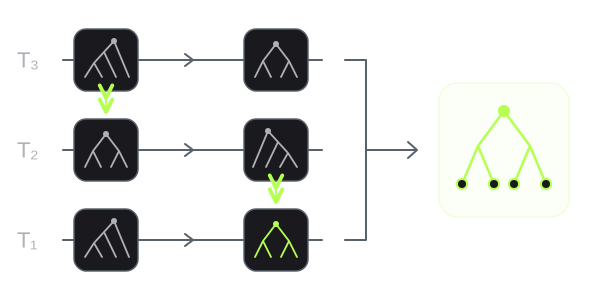
METHOD / 01
Search chains at different temperatures balance exploration and convergence, periodically exchanging candidates. Hot chains help escape local optima, while cold chains retain better contraction orders. Rust handles frequent candidate evaluation and parallel scheduling.
Derive tensors and index connectivity from a quantum circuit.
Temperature chains independently perturb and evaluate candidate contraction orders.
Exchange states according to acceptance probabilities to broaden the effective search.
Select an executable plan using computation and memory metrics.
RESULTS / 02 · PERFORMANCE OVERVIEW
The light optimization scenario compares ArcTN Light with Cotengra Auto; the intensive scenario compares ArcTN Heavy with Cotengra AutoHQ and OMECO. The two overview charts compare contraction-order search time with FLOPs, and total tensor-element reads and writes with the largest intermediate tensor; lower is better for all four metrics.
32 distinct circuits · 5 repeats per circuit · 8 physical cores per run · 3,600-second limit
Tests cover contraction-path search only, excluding numerical tensor contraction. Optimization time measures the search, while FLOPs describe the computational cost of the resulting path.
| Setting | Test setting |
|---|---|
| Task | Contraction-path search (planning only) |
| Input networks | EinsumBenchmark32, containing 32 distinct quantum circuits |
| Repeats | 5 repeats per circuit for every method |
| Optimization objective | FLOPs only |
| CPU allocation | 8 physical cores per run |
| Time limit | External wall-clock limit of 3,600 seconds per run |
| Test size | 32 distinct circuits × 5 repeats, 160 runs total |
| Item | Specification |
|---|---|
| CPU | Intel Xeon Platinum 8253 @ 2.20 GHz |
| Physical cores | 8 sockets × 16 cores, 128 cores total |
| CPU topology | 256 logical CPUs, 8 NUMA nodes |
| System memory | About 2.95 TiB |
| Operating system | Ubuntu 24.04.4 LTS |
| Linux kernel | 6.8.0-117-generic |
| Platform | x86_64; glibc 2.39; CPU path search |
| Software | Version tested |
|---|---|
| Python | 3.12.3 |
| ArcTN | 0.1.0 |
| Cotengra | 0.8.2 |
| cotengrust | 0.2.1 |
| OMECO | 0.2.6 |
| Google TNCO | 0.4.0 |
| NumPy | 2.2.6 |
| opt_einsum | 3.4.0 |
| Optuna | 4.9.0 |
| CMA-ES (cmaes) | 0.13.0 |
| KaHyPar | 1.3.5 |
Google TNCO SA uses a lightweight path search, but the resulting contraction paths have relatively low quality. Across all 32 test circuits, its geometric mean FLOPs are 11.00× those of ArcTN Light and 15.05× those of ArcTN Heavy. Compared with Google TNCO SA, ArcTN Light and ArcTN Heavy achieve end-to-end speedups of 1.06× and 1.25×, respectively. Google TNCO SA is omitted from the per-circuit comparisons.
RESULTS / 03 · METRIC BREAKDOWN
Experiments compare computation, data writes, and intermediate memory across methods. The horizontal axis is a multiple of the lowest value in each chart; lower is better.
Four experimental metric charts.
Measures the floating-point operations required to complete the contraction.
Measures the cumulative number of elements written during the contraction.
Indicates the memory required by the largest intermediate result.
Measures the peak number of elements held in memory at the same time during execution.
LIGHT / ARCTN LIGHT
HEAVY / ARCTN HEAVY
HEAVY / ARCTN HEAVY
DETAILS / 04
The intensive scenario presents circuits of different sizes and structures, comparing ArcTN Heavy with baselines on contraction work and search time to examine how consistently the overall advantages hold per circuit.
The light scenario presents circuits of different sizes and structures, comparing ArcTN Light with Cotengra Auto/CMA-ES, AutoHQ/Optuna, and Hyper128/Optuna on contraction work and search time under limited search budgets.
HEAVY · Result quality Compare contraction work across methods for different circuit sizes and structures.
HEAVY · Search cost Compare the time required to generate contraction orders as another measure of practical usability.
LIGHT · Result quality Compare contraction work across methods for different circuit sizes and structures.
LIGHT · Search cost Compare the time required to generate contraction orders as another measure of practical usability.
REPRODUCIBILITY / 05